VISION – NOT A PRODUCT
When digital infrastructure reaches the physical world.
somsorium does not begin at the screen, and it is not meant to end there either. The same open systems can connect sensors, labs, machines, energy systems and autonomous tools.
We will start on this once the core business can carry it. What you are reading here is where our thinking stands, not an offer.
Physical AI
Software gains a physical side.
smolit can coordinate tools. laborium connects measurement and experiment. Nodes provide computing power on site.
In the long run that gives a basis for systems that do not only process information but work with the physical world – still under human approval.
- Software
- Sensors
- Lab
- Machine
- Energy / environment
Application concept
One example: EcoTechFarms.
EcoTechFarms is an application concept for how somsorium infrastructure could work together in a real system: computing power, renewable energy, sensing, robotics and production.
At a single site, agri-photovoltaics generates electricity, a fleet of compact compute nodes turns it into computing power — and the waste heat warms the greenhouse next door. Many small sites instead of one large plant, fitted into land that is already in use — rather than building on additional green or agricultural land purely for technical infrastructure.
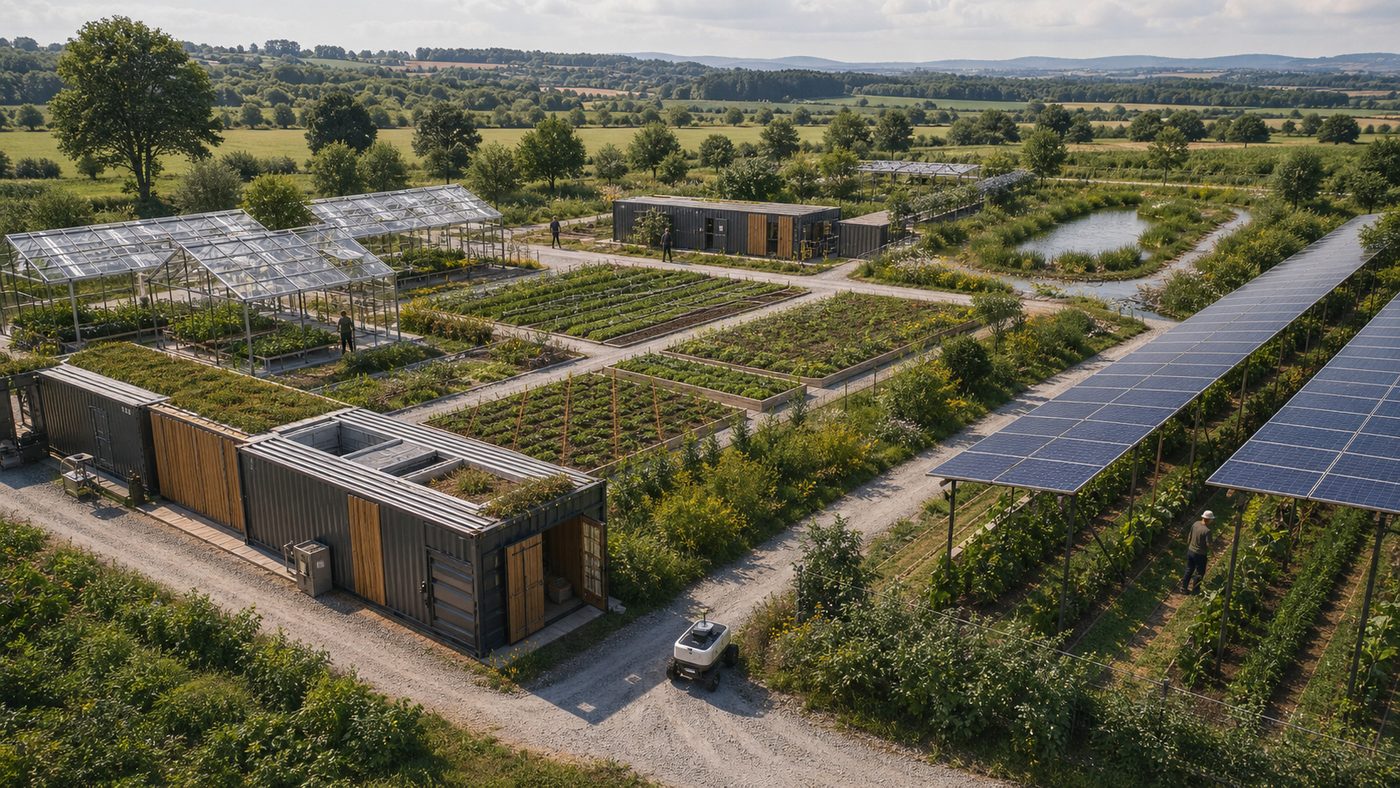
Energy that works twice
Solar poweragrivoltaics on site
Data centreservers provide the compute
Waste heatused instead of lost
Greenhouseheats growing space, later buildings
The grid evens out the peaks and troughs — across a year, generation and consumption balance out on paper.
The building blocks
A site grows in stages.
A central axis carries energy, water and data; three building blocks sit on top of it. That way a site can be extended and rebuilt without touching the whole thing.
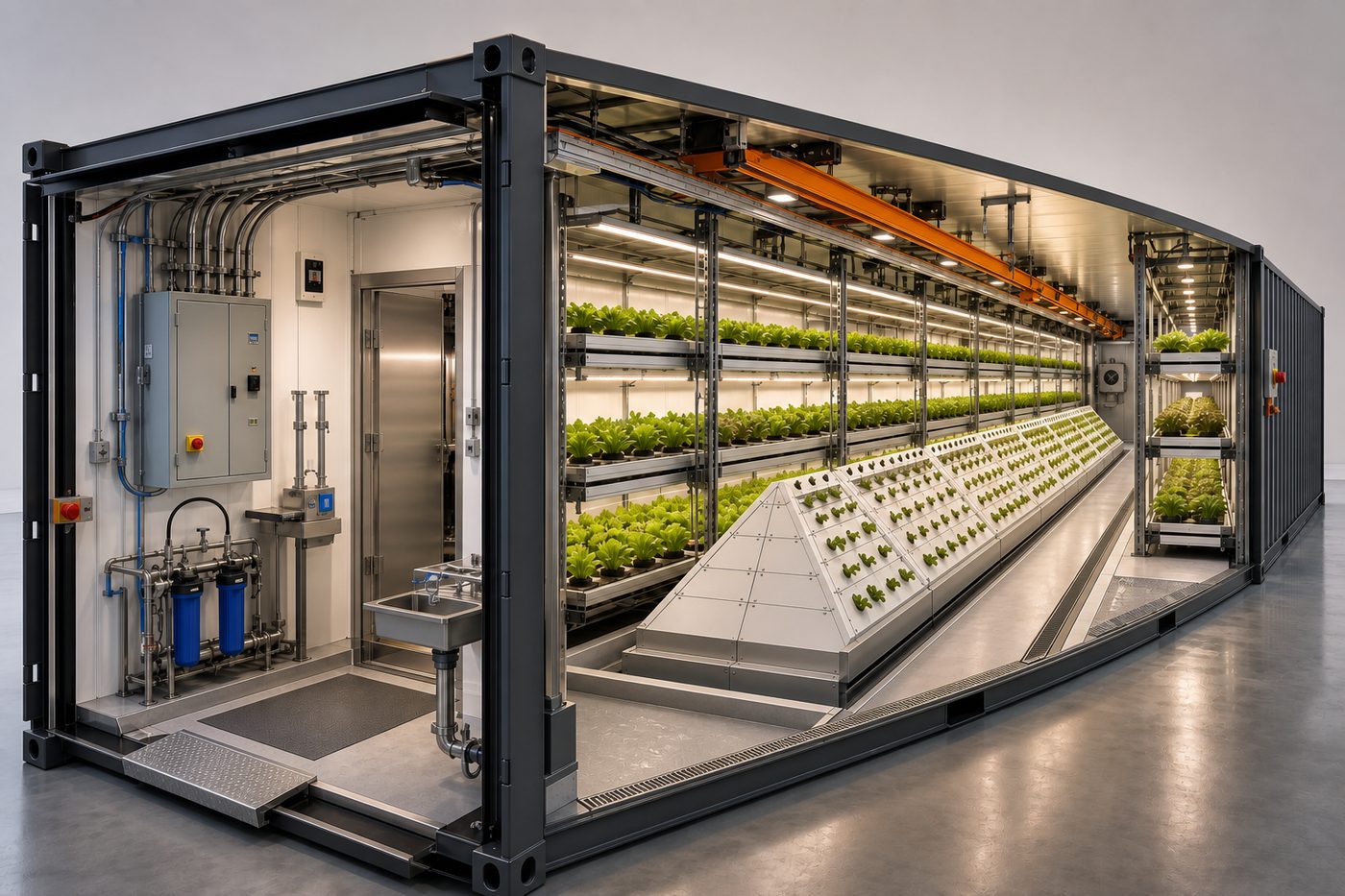
- FarmCell. A closed growing cell the size of a container — climate, water, light and robotics in one transportable unit. If the automation fails, it carries on in safe fallback modes and stays operable by hand.
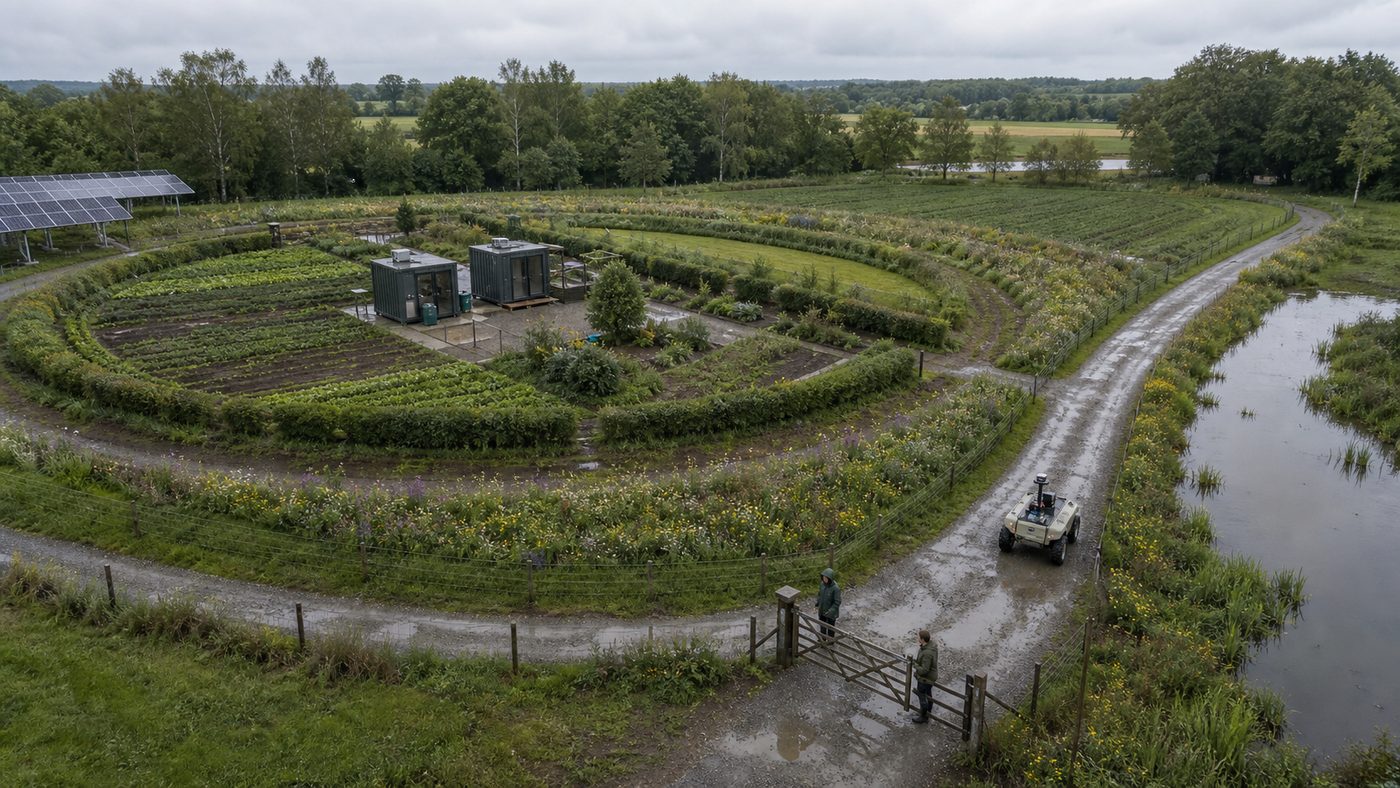
- TerraRing. Functional bands in the open field, concentric around the supply core: service edge, productive field, water retention, habitat strip, robot corridor.
- RoboGrid. Families of robots with tool changers that share the corridors. AI is never the only safety function here — physical limits and mechanical fallback modes come first.
Why this is plausible
Not our numbers — other people’s.
We have no measurements of our own on this. What speaks for it comes from sources anyone can look up.
- Waste heat really is being used. In the Netherlands, waste heat from data centres heats greenhouses with around 95 % reuse. Liquid-cooled return temperatures of roughly 50 to 60 °C match the heat demand of a greenhouse.
- Agri-photovoltaics is tried and tested. Fraunhofer ISE puts the gain in land-use efficiency at up to 60 %; vertical installations keep around 90 % of the ground farmable.
- The rules point in the same direction. The German Energy Efficiency Act requires data centres to reuse increasing amounts of waste heat, and from 2027 to run entirely on green electricity.
EcoTechHouse
The same heat, only for buildings.
A building needs low-grade heat all year round. A data centre produces exactly that as waste all year round. Put the compute nodes where the heat is needed and you save twice.
A buffer store decouples generation from demand: when a lot is being computed, heat is stored; when the building needs heat, the buffer gives it back. Ordinary building services cover the peaks. The waste heat covers the base load — no more than it honestly can.
Not just one place
The same infrastructure. Other places.
EcoTechFarms is one example, not the definition of somsorium. The same building blocks fit wherever computing power, measurement and physical processes come together.
Buildings
Computing power, heat storage and building services.
Labs
Sensors, instruments, experiments and automation.
Workshops
Local AI, machines and digital fabrication.
Agriculture
Energy, robotics, sensing and biological systems.
How it fits into the ecosystem
Measure first, build second.
With complex physical systems we do not begin with a large installation. We begin with data, models, small experiments and assumptions that can be checked.
Several somsorium building blocks would come together here: the compute nodes would supply the capacity, laborium would stand behind the control of cells and reactors, and the agents would watch over operation — always with a human in the approval loop.
The order stands: measure first, build second.
No sugar-coating
What of this is concept today.
- Nothing is running anywhere and no building has been built. EcoTechFarms is a design, EcoTechHouse a feasibility analysis.
- Areas, capacities, heat volumes, sizing and economics are assumptions, not commitments.
- All visualisations are AI-generated concept images, not a basis for planning.
- The legal form and the route to implementation are open too. We are working the ideas through and keeping them open.